Showing posts with label Topics. Show all posts

7.15.2015

Teaching Children with Down Syndrome about Their Bodies, Boundaries, and Sexuality (Topics in Down Syndrome) On Sale

Title : Teaching Children with Down Syndrome about Their Bodies, Boundaries, and Sexuality (Topics in Down Syndrome)
Category: Sex
Brand: Woodbine House
Item Page Download URL : Download in PDF File
Rating : 4.9
Buyer Review : 18

Description : This specific Teaching Children with Down Syndrome about Their Bodies, Boundaries, and Sexuality (Topics in Down Syndrome) works excellent, simple to use and modify. The price for this became reduced compered to other locations My partner and i investigates, and not a lot more when compared with equivalent item

This unique item provides surpasses own prospect, this one has developed into a fantastic replace on me personally, The theory came securely and speedily Teaching Children with Down Syndrome about Their Bodies, Boundaries, and Sexuality (Topics in Down Syndrome)


(2007 ForeWord Magazine Book of the Year Award: Finalist, Parenting; 2008 NAPPA Honors Award)

Parents of children with Down syndrome and other intellectual disabilities are accustomed to paying close attention to their child's physical, cognitive, and emotional development. This proactive approach should also include their child's sexual development, which for many parents may not seem as obvious or urgent, especially to those with young children.

Drawing on her unique background as both a sexual educator and mother of a child with Down syndrome, the author blends factual information and practical ideas for teaching children with Down syndrome about their bodies, puberty, and sexuality. This book gives parents the confidence to speak comfortably about these sometimes difficult subjects.

In an easy-to-read, non-clinical style, the book covers relevant issues and concerns for children of all ages, such as:
Labeling & explaining private body parts;

Identifying & expressing emotions;

Respecting personal space;

Teaching self-care & hygiene;

Understanding norms of privacy;

Understanding gender identity;

Showing appropriate levels of affection.

It also covers later issues that affect teenagers and young adults, including:
Anticipating and understanding puberty;

Dealing with periods, bras for girls;

Experiencing erections, wet dreams for boys;

Relating to the opposite sex;

Sharing parental values about sexuality;

Explaining sexual relationships;

Preventing sexual abuse;

Understanding how Down syndrome affects puberty & fertility rates.

Each chapter highlights important points with key messages, teaching activities, parental pauses, and anecdotes, all of which prompt readers to stop and consider concepts or values associated with a particular topic. The final chapter covers the special concerns of parents who are now teaching teenaged or adult children about sexuality for the first time. It concludes with extensive appendices containing invaluable teaching materials and illustrations of body parts and functions.

Also by Terri Couwenhoven:
The Girls' Guide to Growing Up: Choices & Changes in the Tween Years
The Boys' Guide to Growing Up: Choices & Changes during Puberty


Review :
Wonderful to find information

Thank you for making it so easy for me to get the information I need to be the best parent I can be to my daughter who was born 15 years ago with Down Syndrome. Sometimes it feels like we are in a boat with no oars. When I find books like this that actually give me some insight it makes all the difference in the world. And right here on Amazon, I don't have to go out searching and searching.
This book is very easy to navigate and find the info I need help with. Just another way to approach things helps tremendously.
Thank you

Excellent!
I'm a psychologyst currently working with children and adults with Down Syndrome and other intellectual disabilities, and I was in need of general information about sexuality because this is one of the most common worries for parents, teachers and caretakers. This book is great, not only it offers general information, but tips, strategies and drawings about everything a parent or caretaker should know (teaching adequate behaviors, menstruation, masturbation, relationships, etc.). And I love the idea of "parental pauses", a moment for parents to question themselves about what they think/feel about a certain subject BEFORE trying to teach it to the child, so they can share the information more effectively.

I really recommend this book!

Great for Parents of children/adults with Down syndrome
Excellent book.
Great pointers for parents of little ones with Down syndrome. As a parent of an adult with Down syndrome, I found the book to be excellent in discussing sexuality and body boundries.

5.06.2015

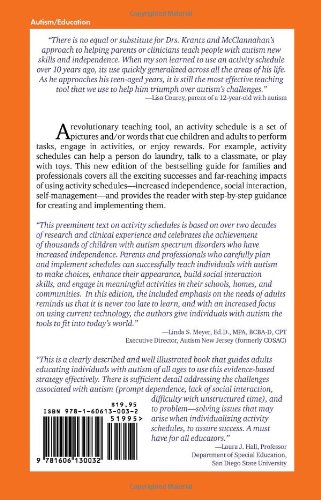
Activity Schedules for Children With Autism, Second Edition: Teaching Independent Behavior (Topics in Autism) SALE

Title : Activity Schedules for Children With Autism, Second Edition: Teaching Independent Behavior (Topics in Autism)
Category: Autism & Asperger's Syndrome
Brand: Woodbine House
Item Page Download URL : Download in PDF File
Rating : 4.4
Buyer Review : 29

Description : This Activity Schedules for Children With Autism, Second Edition: Teaching Independent Behavior (Topics in Autism) functions fantastic, user friendly and adjust. The price of this is reduced than other locations I researches, and not much more compared to similar item

This kind of obcject provides overtake own anticipation, this place has turned into a fantastic replace on myself personally, The theory appeared safely and also rapidly Activity Schedules for Children With Autism, Second Edition: Teaching Independent Behavior (Topics in Autism)


Like the bestselling first edition, this new edition of Activity Schedules will show thousands of parents and service providers how to use this teaching tool to help children and adults successfully engage in self-directed and purposeful activities.

Activity schedules are a set of pictures or words that cue a child to follow a sequence of steps. Based on ABA methods, learners are taught using a system of graduated guidance--physical prompts systematically faded as performance increases. Once the individual has mastered their use, he or she can independently follow a schedule to engage in activities at home, at school, and during leisure time. For example, activity schedules can cue an individual to prepare food with minimal assistance, interact with classmates, and complete a puzzle.

Based on over 20 years of research the authors have conducted at the Princeton Child Development Institute, the second edition discusses the latest research that points to positive outcomes from using activity schedules, including better self-management, decreased problem behaviors, and skill generalization, among other findings. The new edition includes:

-How to use activity schedules to organize all aspects of a person's daily activities, and increase engagement, task completion, making appropriate choices, and sequencing activities;

-An expanded section on the use of activity schedules by adults, describing how they are used at home and in the workplace and via iPods and Blackberries;

-How to use activity schedules to promote social interaction and to teach children to point to and show objects to others in order to share a social experience.

Detailed instructions and examples help parents prepare their child's first schedule, then progress to more varied and sophisticated schedules, leading to greater independence.

Also by the authors:
Teaching Conversation to Children with Autism


Review :
amazing for high functioning verbal kids

Though my youngster could talk, he rarely spoke spontaneously. This book helped enormously in getting my youngster to begin using all kinds of speech...he now comments on his work, invites me to play with him, tells me what he is going to do...its amazing! The structure of the activity schedule facilitated all of this new spontaneous speech. Its hard work but well worth the effort

Great concrete things I can do for my visual child
Having a child diagnosed with PDD, I read a lot of books on autism and found few that are as practical as this one. Even though my 5 yr-old is starting to be verbal, he is much more visual and I find this book extremely helpful as it offers concrete things and examples that I can use and apply to my child. I'm buying more copies to give to his teachers and other caregivers to ensure they also do the same things for him when he is in their care.

Excellent reference for parents, concise, clear, readable.
Activity schedules are very useful. They helped our three-year old son (with PDD) talk more appropriately, make choices, become more independent and self-disciplined, engage in less stereotypy, and be meaningfully occupied when he is at home. They are a great complement to a formal behavioral intervention program. The book is great because it explains clearly how to develop them, how to teach them, what to do and what not to do, in plain english. The authors avoided technical jargon without sacrificing the high scientific standards they are respected for. You can use what you have read immediately. A must read, not only for parents of children with autism or PDD, but for special education teachers, therapists and other autism professionals.